


The UK is a well-established study destination for students from Kuwait, with Kuwaiti students enrolled across universities in England, Scotland, Wales, and Northern Ireland. While opportunities are wide-ranging, understanding university entry requirements and the student visa process is essential before applying.
This guide is written specifically for Kuwaiti students who are planning to study in the UK. It provides an overview of:
- Academic and English language entry requirements
- Required documents, financial and medical considerations
- Typical tuition fees and living costs in the UK
-
Government-Funded Scholarships for Kuwaiti Students
- The UK student visa process for Kuwaiti nationals
- Frequently asked questions
Whether you are comparing universities, preparing documents, or getting ready to submit your application, this guide is designed to offer practical clarity at each stage of the UK study process.
Get a free UK study assessment for Kuwaiti students
Speak to an experienced UK education consultant and get personalised guidance on courses, requirements, and the visa process.
Entry Requirements for Kuwaiti Students

Academic Entry Requirements
Entry requirements for Kuwaiti students vary by university and course level, but most UK institutions follow similar assessment principles. The pathway you are offered will usually depend on your previous qualifications, grades, and English language level.
Undergraduate Study
Direct entry to Year 1
Kuwaiti students may be considered for direct entry to the first year of a Bachelor’s degree if they have completed:
- UK A levels, or
- The International Baccalaureate (IB)
For highly competitive courses such as Medicine or Dentistry, A levels or IB are usually required.
Foundation programmes
Students who have completed the Shahadat-al-Thanawia-al-A’ama (Kuwaiti Secondary School Certificate) are generally required to complete an international foundation programme before progressing to an undergraduate degree.
- Higher secondary school grades may allow access to integrated foundation programmes, particularly in subjects such as Science, Engineering, or Technology
- Subject-specific requirements (for example, Mathematics or Physics) often apply
Foundation programmes are commonly delivered by universities directly or through associated international colleges.
Advanced or transfer entry
Some universities may consider:
- One or more years of study at a recognised Kuwaiti university
- Diplomas from recognised technical institutes or vocational institutions
- Higher Diplomas or Higher National Diplomas (HNDs)
These qualifications are usually assessed on a case-by-case basis for entry into Year 1 or Year 2 of an undergraduate degree, depending on subject relevance and grades.
Postgraduate (Master’s) Study
To apply for a taught Master’s degree, Kuwaiti students are normally required to have:
- A Bachelor’s degree from a recognised institution
- A minimum GPA, typically ranging between 2.6/4.0 and 3.2/4.0, depending on the university and course
Some postgraduate courses may also require:
- Relevant academic background
- Work experience
- Specific subject knowledge
If entry requirements are not met, a pre-Master’s programme may be offered as an alternative route.
Doctoral (PhD) and Research Degrees
For PhD or research-based programmes, universities generally require:
- A strong Master’s degree from a recognised university
- A research proposal aligned with the university’s expertise
Postgraduate research degrees are individually supervised, and applicants are often encouraged to contact a potential supervisor or academic department before submitting a formal application.
Important to Note
- Entry requirements vary significantly by course, university, and intake
- Meeting minimum academic requirements does not guarantee admission
- Applications are assessed individually, taking subject relevance and overall profile into account

English Language Requirements
UK universities require international students, including those from Kuwait, to meet course-specific English language requirements as part of the application process. English ability is assessed and confirmed by the university at the course level.
Minimum English Level for a UK Student Visa
UK Visas and Immigration (UKVI) sets a minimum English level (commonly referred to as B2) for student visa purposes. In practice, most UK universities require a higher level of English, depending on the course and subject area.
The English requirement you need to meet is therefore determined primarily by the university and the specific course, rather than by nationality.
Accepted English Language Qualifications
UK universities commonly accept a range of English language qualifications, including:
- IELTS
- TOEFL
- PTE Academic
- IGCSE or O-level English (at specified grades)
- International Baccalaureate English (Language or Language and Literature)
The exact score or grade required varies by university and course.
Course-Specific Requirements
English language requirements vary by subject and level of study. For example:
- Courses in Medicine, Health, Law, or Education often require higher English scores
- Some postgraduate courses may accept slightly lower scores if supported by academic background or work experience
Universities assess English ability at the course level, not just at the country level.
Conditional Offers and English Preparation
Many UK universities issue conditional offers, allowing Kuwaiti students to meet the English language requirement before the course starts. If a student does not meet the required English level at the time of application, some universities may offer
- A pre-sessional English course
- An integrated English and academic pathway programme
These options allow students to improve their English while preparing for academic study in the UK.
Required Documents, Financial Evidence & Medical Requirements

Key Documents Needed for University Applications
In addition to academic and English language requirements, Kuwaiti students must prepare a set of documents that will be used by both the university and, eventually, UK Visas and Immigration (UKVI) as part of the visa application.
Most UK universities ask for:
- Academic transcripts and certificates
- Proof of English language proficiency
- A current passport or national ID
- A personal statement
- References or letters of recommendation (where required)
These documents help universities assess your application and issue a Confirmation of Acceptance for Studies (CAS) once you meet their requirements.
For a complete and up-to-date list of required documents, refer to our UK Student Visa Documents Checklist

Financial Evidence for Visa Purposes
To apply for a UK Student visa, students are normally required to show that they have enough funds to cover tuition fees and living costs. However, Kuwaiti nationals benefit from the UK’s “differential evidence requirement.”
What This Means for Students from Kuwait
If you are a Kuwaiti national, you are not usually required to submit financial evidence (such as bank statements) with your UK Student visa application.
This includes evidence for:
- Tuition fees
- Living costs for the first year of study
Kuwait is listed by the UK Government as a country under the differential evidence requirement.
Important to Note
- You must still meet the financial requirement, even if you are not asked to provide documents at the time of application
- UK Visas and Immigration (UKVI) may request financial evidence later in some cases
- Students should ensure funds are genuinely available before applying
If your application is selected for further checks, you may be asked to provide:
- Bank statements
- Sponsorship letters (if applicable)
- Scholarship confirmation (if applicable)
Because requirements can change, students are advised to check the latest guidance on the official UK Government website before submitting their visa application.

Medical Requirements
Some UK visa applicants must take a tuberculosis (TB) test before their application if they have lived in certain countries for six months or more. The UK Government publishes a list of these countries on the official UK Visas and Immigration (UKVI) website.
Kuwait is currently not on the list of countries that require a TB test certificate for a UK student visa. This means that most Kuwaiti students will not need to provide a TB test as part of their student visa application. However, healthcare requirements and public health screening may still apply once you arrive in the UK as part of the university’s enrolment or NHS guidelines.
If you have lived in another country that is on the UKVI TB list for six months or more within the 12 months before applying, you may need to provide a TB certificate from an approved clinic. In that case, you should check the official UK Government guidance for the latest requirements.
Not sure if you meet the UK entry or visa requirements?
We review your qualifications, English level, and funding before you apply.
Typical tuition fees and living costs (2026)

The cost of studying in the UK for Kuwaiti students depends on the level of study, the course, and the university location. Fees and living costs vary significantly between institutions and cities, so it is important to plan your budget early.
Tuition Fees
Typical annual tuition fees for international students are:
- Undergraduate degrees: usually range from £11,000 to £25,000 per year
- Postgraduate taught degrees: typically range from £12,000 to £30,000 per year
Specialist courses such as Medicine, Dentistry, or laboratory-based programmes often have higher tuition fees.
If you are considering more affordable options, see our guide: Cheapest UK Universities for International Students (2026)
Living Costs
Living costs depend largely on where you choose to study.
- London: living costs are higher, typically around £1,300–£1,500 per month, mainly due to accommodation and transport
- Outside London: generally more affordable, with average living costs of around £1,000–£1,200 per month
Living costs usually include accommodation, food, transport, and personal expenses. Universities provide estimated budgets to help students plan realistically.
Other Costs to Consider
In addition to tuition and living expenses, Kuwaiti students should also budget for:
- Visa application fees
- Immigration Health Surcharge (IHS)
- Course materials and equipment
- Travel and initial settlement costs
Planning for these costs in advance helps avoid financial pressure after arrival.
Government-Funded Scholarships for Kuwaiti Students
Some Kuwaiti students study in the UK with government-funded sponsorship managed through the Kuwait Cultural Office (KCO) and the Ministry of Higher Education.
Students who are awarded a government scholarship are usually required to register with the Cultural Office and follow official procedures related to course approval, university selection, and ongoing study requirements.
Approved courses, universities, and sponsorship conditions are determined by the Kuwaiti authorities and can change from year to year. Students are advised to check the official Cultural Office guidance directly for the most up-to-date information.
Official student guidance and approved study information is available on the Kuwait Cultural Office website
The UK student visa process for Kuwaiti nationals
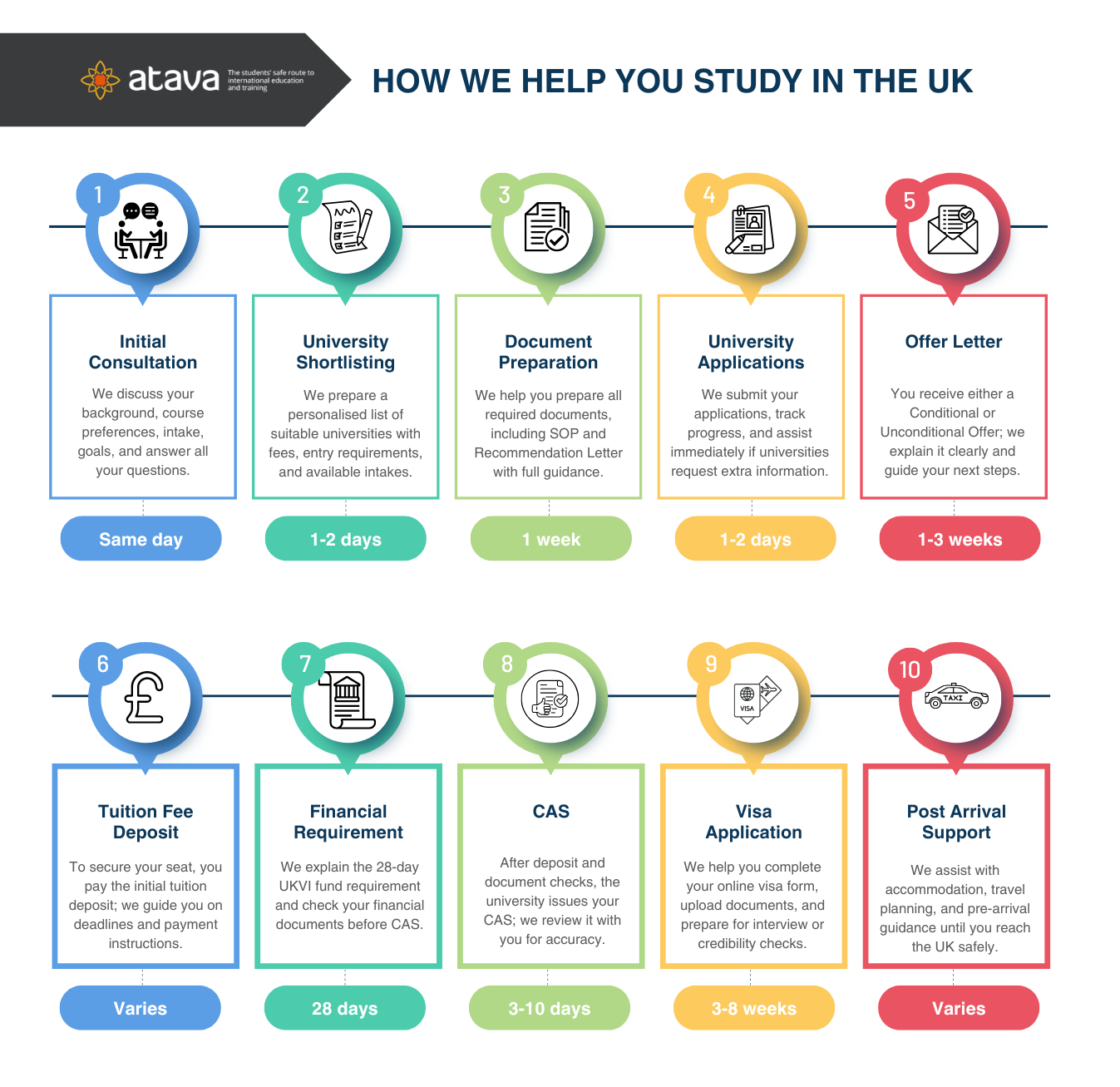
Below is an overview of the key stages involved in studying in the UK and how Atava supports Kuwaiti students throughout the university application and visa process.
Atava’s Membership in the Arab-British Chamber of Commerce

Atava Education & Training is a member of the Arab‑British Chamber of Commerce (ABCC), a long-established, non-political membership organisation that promotes trade, investment, and professional cooperation between the United Kingdom and Arab countries.
This membership reflects Atava’s engagement with UK-Arab professional networks and its commitment to supporting students and families from the Arab region who are exploring UK education opportunities. Through its association with the ABCC, Atava aligns itself with a wider community of organisations involved in UK-Arab collaboration, reinforcing trust, transparency, and long-term cross-border engagement.
Frequently Asked Questions
When should Kuwaiti students start applying to UK universities?
There is no fixed deadline, but Kuwaiti students are generally advised to start preparing around 6–9 months before their intended intake. This allows time for university applications, meeting any offer conditions, CAS issuance, and visa preparation.
Which intakes are available for Kuwaiti students?
Most UK universities offer September and January intakes, with a smaller number of courses available in May. Intake availability depends on the course and university, so students should check course pages carefully.
Do Kuwaiti students need to show bank statements for a UK Student visa?
Kuwaiti nationals fall under the UK’s differential evidence requirement, which means they are not usually required to submit financial documents with their visa application. However, students must still meet the financial requirement and may be asked to provide evidence if requested by UKVI.
Is IELTS compulsory for Kuwaiti students?
Not always. While IELTS is widely accepted, some universities may accept alternative English qualifications such as IGCSE English, International Baccalaureate English, or other recognised tests. English requirements are set by the university and vary by course.
Can Kuwaiti students work while studying in the UK?
Most students on a UK Student visa are allowed to work up to 20 hours per week during term time and full-time during official holidays, subject to the conditions stated on their visa.
Can Kuwaiti students bring family members to the UK?
Eligibility to bring dependants depends on the level and duration of the course and current UK visa rules. Not all students are eligible, and dependants must meet separate visa and financial requirements.
Do Kuwaiti students need a TB test for a UK Student visa?
Kuwait is not currently on the UK Government list of countries that require a TB test for a UK Student visa. However, students who have lived in another listed country may need to provide a TB certificate.
How long does the UK Student visa process take?
Once a complete visa application is submitted:
- Applications made outside the UK are usually decided within around 3 weeks
- Applications made inside the UK can take up to 8 weeks
Processing times may be longer during busy periods, so students should allow sufficient time before their intended travel date.
Planning to study in the UK from Kuwait?
We support you from course selection to visa approval and post-arrival in the UK.